
Whispers Across Worlds: The Divine Dance of Aeons and Archons in HoYoverse's Tapestry
Discover how Aeons and Archons shape their realms with distinct philosophies, divine power, and fascinating cosmic interplay.
In the vast, shimmering canopy of the Imaginary Tree, where worlds hang like glistening leaves, two distinct realms hum with their own divine melodies. One, Teyvat, cradled by the whispers of seven elemental Archons. The other, a cosmos adrift on the stellar rails, guided by the enigmatic philosophies of the Aeons. They are not neighbors, not even sharing the same soil of reality, yet their stories seem to echo across the void, carried on the same cosmic wind. It's a connection that feels less like a coincidence and more like a secret shared between old friends who have never met. Through subtle winks in the lore and the grand, improbable journey of figures like Welt Yang—who somehow hopped universes—the HoYoverse multiverse stitches its tales together, suggesting that all gods, in their own way, are listeners at the same celestial window.
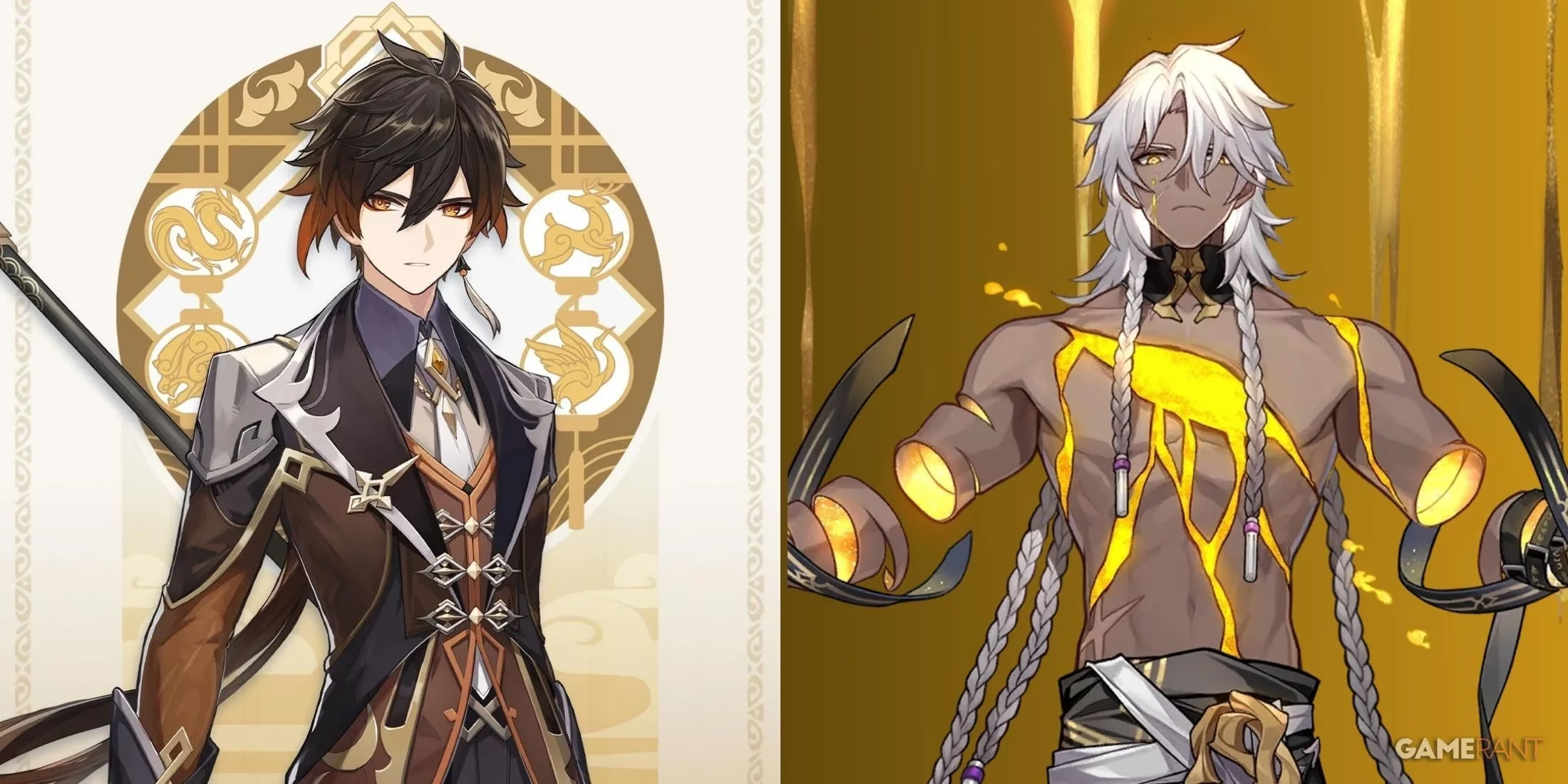
At their core, both Aeons and Archons are the gods of their domains, the architects of rules and the wellsprings of power for their followers. They play the part of the classic deity: bestowing blessings, engaging in earth-shattering squabbles with their peers, and generally being, you know, a bit extra. Their very existence is woven into the fabric of their world's gameplay, defining how mortals interact with the challenges before them. But oh, how differently they go about it.
The Nature of Divine Bestowal: Rule vs. Path
The Archons' Sovereign Gift
In Teyvat, divinity feels... territorial. The seven Archons preside over their nations and their elements like monarchs over chosen lands. The power of Anemo, Geo, Electro, and the rest is a gift—or perhaps a selective resonance—granted to a chosen few within their domain. Does the Archon consciously choose who wields their element? The lore plays coy with that answer. It's a system of patronage, where worship from the many fuels the god, but tangible power is bestowed upon the few. The nation and its people are an extension of the Archon's will.
The Aeons' Open Road
In contrast, the cosmos of Honkai: Star Rail offers a more... democratic divinity. Aeons don't rule planets; they illuminate Paths. These are not elements of matter, but ideals and philosophies given form: The Hunt for singular focus, The Abundance for boundless life, The Preservation for unwavering defense. Anyone, from any corner of any world, can choose to walk a Path. There's no application process. The power you harness depends not on a god's favoritism, but on your own emotional conviction and dedication to that ideal. The Aeon is less a ruler and more a beacon; the follower's faith is the true catalyst. It's the difference between being knighted by a king and finding your own true north by following a star.
The Mechanics of Power: Elements vs. Ideals
Let's break down how these divine frameworks translate to the player's experience:
| Aspect | Genshin Impact's Archons & Elements | Honkai: Star Rail's Aeons & Paths |
|---|---|---|
| Core Concept | Governing tangible, reactive elements (Anemo, Pyro, etc.) | Embodying abstract philosophies and ideals (Hunt, Erudition, etc.) |
| Gameplay Role | Drives Elemental Reactions (Melt, Vaporize) and team Elemental Resonance buffs. | Defines a character's combat role and skill set (Healer, Single-Target DPS, Support). |
| Divine Example | Barbatos, Anemo Archon → Commands the wind. | Yaoshi, Aeon of Abundance → Champions the perpetuation of life → Grants healing powers. |
| Scale of Influence | Primarily contained within Teyvat and its nations. | Cosmic; followers span multiple planets and civilizations. |
This table shows the fundamental split: Archons deal in the physics of their world, while Aeons deal in the psychology of existence. One asks, "What element do you command?" The other asks, "What principle do you live by?"
The True Immortality: Legacy Over Life
Perhaps the most profound parallel between these celestial beings is the notion that true power outlives the god themselves. In HoYoverse, you don't necessarily have to be alive to be influential. Talk about leaving a mark!
-
In the cosmos, the Astral Express continues to blaze trails, harnessing the Path of the Trailblaze long after its founding Aeon, Akivili, is said to have vanished or died. The philosophy itself is the engine.
-
In Teyvat, the elements of fallen gods don't fade. They linger, waiting. A vacant elemental throne can be filled by an existing Archon expanding their portfolio, or by a mortal who ascends to grasp that elemental authority. The power remains; only the wielder changes.
This shared truth is a beautiful, haunting piece of worldbuilding. It whispers that in these universes—and maybe in ours—immortality isn't about endless life, but about an indelible legacy. The idea, the path, the element... these become eternal. The god may be the first author of the story, but the story itself takes on a life of its own, written anew by every follower who finds meaning in it. It's enough to make you think, huh?
The Scale of a God's Reach
When it comes to raw, universe-shaking potential, the scale tips. Aeons operate on a galactic, sometimes reality-altering level. Their conflicts can birth or obliterate worlds, and their followers are scattered across star systems. Their power is tied to concepts that transcend geography. Archons, while unimaginably powerful within Teyvat, are intrinsically linked to their one world, their one nation. Their drama is the drama of a continent, not a cosmos. It's not that one is "stronger" in a straightforward sense—it's that their playing fields are of different dimensions entirely. An Archon might reshape a nation's landscape; an Aeon might debate the fundamental value of existence across a thousand landscapes.
In the end, gazing upon the Imaginary Tree, one sees not a hierarchy of gods, but a symphony of divine expression. The Archons sing the song of the world, of earth, wind, and water given will. The Aeons hum the melody of the mind, of hunt, preservation, and remembrance given form. They are different verses composed with similar notes of worship, power, and legacy. Through Welt's journey and the subtle threads in the lore, HoYoverse suggests these songs can hear each other across the branches, a silent, knowing recognition between forces that shape realities in their own unique ways. Their connection is the multiverse's most captivating secret, a reminder that all stories, no matter how distant, might just be paragraphs in the same grand, unfolding tale.