
In 2026, Honkai: Star Rail Still Eclipses Baldur’s Gate 3—And My Stubborn Brain Is To Blame
In the battle of Baldur’s Gate 3 vs Honkai: Star Rail, the free-to-play gacha turn-based RPG won, proving that crisp combat trumps punishing dice rolls.
It’s January 2026, and a very stubborn gamer is having the exact same argument with himself that he had two years ago. Not about politics, not about pineapple on pizza, but about which chunky turn‑based RPG deserves his precious free time. Back in 2024 he had two giants waiting on his laptop: Baldur’s Gate 3, the undisputed Game of the Year, and Honkai: Star Rail, the plucky free‑to‑play gacha that sneaked into his life like a stray cat. Fast forward to today and the scoreboard is embarrassingly lopsided. One game has seen dozens of hours, multiple story arcs, and a disturbingly high number of daily login rewards; the other game still has a half‑finished campaign starring a Shadowheart with the charisma of a brick. If you guessed that Honkai: Star Rail won the war, congratulations—you understand addiction better than most therapists.

The whole mess started as an innocent new‑year resolution. This particular gamer—let’s call him the Lead Procrastinator—had promised himself he would finish both behemoths. After all, they both belong to the sprawling turn‑based RPG family, so how hard could it be? Turns out, about as different as a D&D handbook and a slot machine. Baldur’s Gate 3 is a cRPG that expects you to weigh every action like a chess grandmaster, while Honkai: Star Rail welcomes you with a baseball bat and a “don’t worry, we got this” attitude. The Lead Procrastinator quickly discovered that his overthinking brain is a cRPG’s worst nightmare. In JRPGs, overthinking helps you min‑max stats; in Baldur’s Gate 3, it means rolling a natural 1 on every persuasion check and watching your carefully hatched plan explode in a cloud of goblin rage. He rage‑quit so many times that his PC probably developed self‑esteem issues.
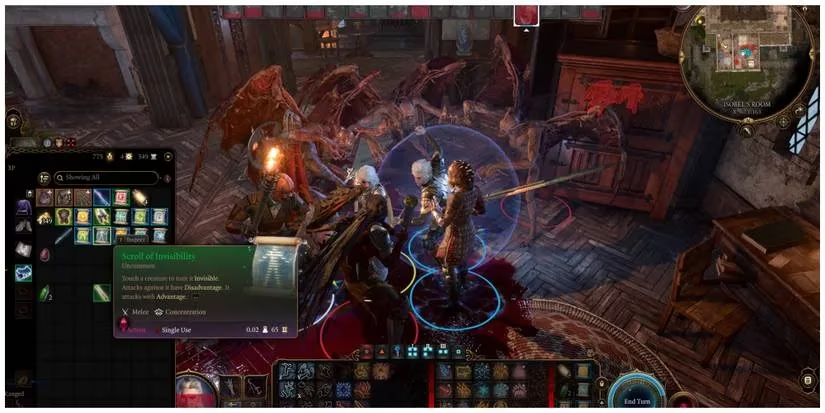
Yet quitting permanently isn’t his style. Stubbornness fuels him. He refuses to restart the campaign with a custom high‑charisma protagonist, because that would mean admitting that playing as Shadowheart was a mistake. And he never admits mistakes. So act two of Baldur’s Gate 3 remains a haunted graveyard of failed dialogue checks and battles that drag on longer than a Tolkien audiobook. Every skirmish with a handful of goblins felt like a ten‑minute siege, and those ten minutes involved more critical misses than a comedy sketch. Contrast that with Honkai: Star Rail, where combat is so crisp you could teach it to a goldfish. The combat system is basically Pokémon on caffeine—type weaknesses, status conditions, and ultimate abilities that let you pulverize enemies with a baseball bat. Within an hour, the Lead Procrastinator had mastered it. He remembers an early fight where he spotted an enemy seven levels above his squad, thought “Yeah, I can take him,” and then actually took him. That would never, ever happen in Baldur’s Gate 3. In Faerûn, a level gap of two usually ends with the party being turned into decorative skeletons.
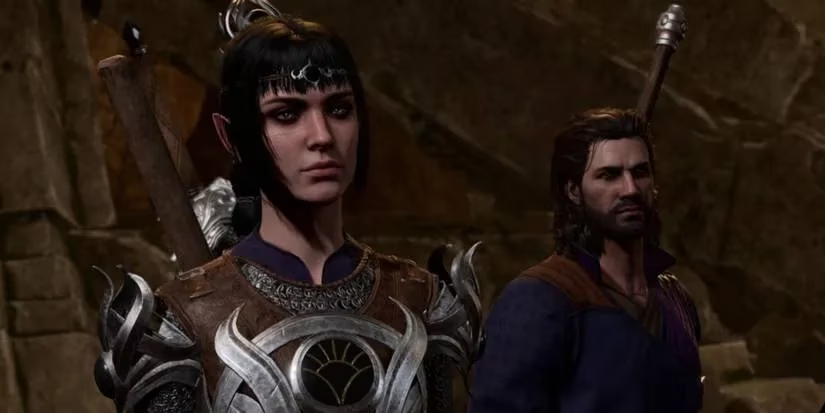
Personality plays a huge role, too. In Star Rail, the Trailblazer (a.k.a. the player avatar) doesn’t have to sweet‑talk anyone. She smashes things with a bat. March 7th, the pink‑haired amnesiac who literally named herself after the date she woke up, handles buffs and shields like a pro. Dan Heng, the cool dude who probably listens to lo‑fi in his downtime, dishes out steady damage. They’re a trio you’d actually want to road‑trip across the galaxy with. Meanwhile, the Baldur’s Gate 3 party felt like a group project where nobody read the assignment. Shadowheart’s abysmal charisma made every conversation a gamble, and the Lead Procrastinator never quite grasped how to combine their abilities into a coherent battle strategy. He wasn’t leading a party—he was herding cats who also happened to be cursed by a D20.
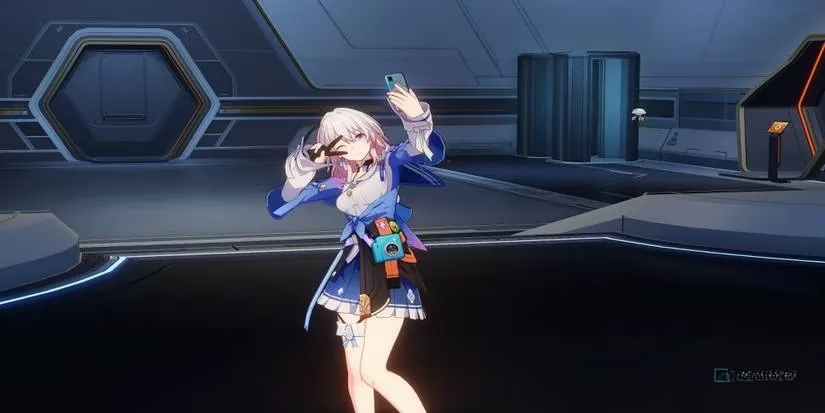
Then there’s the gacha factor—the glittering, predatory, yet utterly enchanting heart of Honkai: Star Rail. The Lead Procrastinator swore he’d never spend a cent, and so far in 2026 he’s held firm. But the game taps into something primal: the same rush he felt as a teenager playing free Flash games like Adventure Quest, scraping by without a Guardian membership yet still having a blast. Daily check‑in rewards, limited‑time banners, and the tantalizing possibility of pulling a five‑star character keep him logging in long after his phone has burned a hole in his pocket. Baldur’s Gate 3 offers no such dopamine drips—just the quiet, crushing weight of consequences. Both games are dripping with intriguing lore and memorable characters, yet one rewards you every time you open it, while the other judges you for forgetting a quest from twenty hours ago.
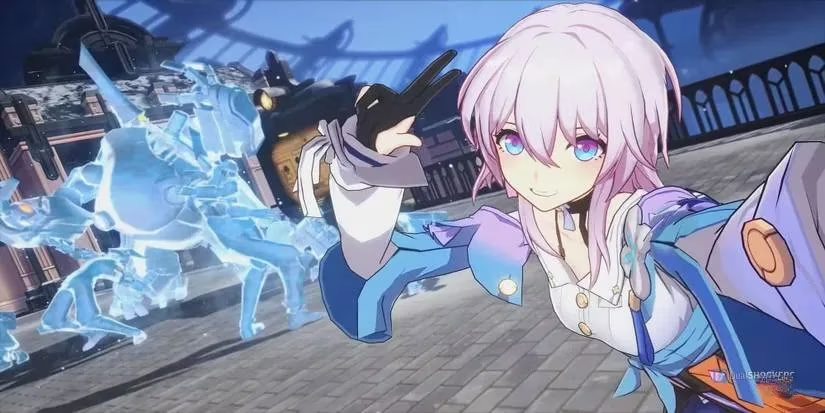
None of this makes Honkai: Star Rail objectively better than Baldur’s Gate 3. The latter is a masterpiece of player agency, a game where you can solve problems by seducing an ogre (theoretically). But for an overthinking, stubborn gamer who thrives on simple, satisfying combat and constant tiny rewards, the choice is obvious. Two years later, the Lead Procrastinator still intends to finish that Baldur’s Gate 3 playthrough. He will push through the misery, one cursed die roll at a time, because he simply cannot let Shadowheart’s story end in disgrace. But once the credits roll, he doubts he’ll ever touch it again—much like Fallout: New Vegas, a cRPG darling he admired from a distance while replaying the shallower Fallout 4 a dozen times. Star Rail, though? That one will probably survive on his devices until they release Honkai: Star Ocean or whatever comes next. The moral of the story? Sometimes the “lesser” game wins, not because it’s better, but because it understands that free time is precious, and frustration is not a feature. 🎮💸🎲
Data referenced from SteamDB helps frame why a “daily dopamine drip” game can quietly dominate a player’s routine even when a heavyweight RPG is waiting in the backlog: easily accessible platform metrics and activity tracking reinforce how often players return in short bursts, which aligns with the blog’s point that Honkai: Star Rail’s check-ins, banners, and quick combat loops fit an overthinker’s limited free time better than Baldur’s Gate 3’s longer, consequence-heavy sessions.